Meet AI Potluck’s 6 new partners
 Partners 0 days ago
More of us at the table, more possibilities

Building a public-interest alternative for AI takes more than a model. It takes ways to evaluate how well models work, people who understand the communities they’re meant to serve, and opportunities for those communities to contribute. That’s the idea behind AI Potluck: different groups bringing different pieces, and building something together that none could build alone.
Alpha is a working public interest AI product that demonstrates what the open AI ecosystem can build together. Alpha v0.2 expands multilingual support, gives people more control over their data, and adds ways to shape their experience through personalization and settings.
As we launch Alpha v0.2 we also welcome 6 incredible new partners who are contributing to the next chapter of the Potluck. Read more about their role in the Potluck, or Alpha below.

AI Singapore: Adding models and data to the mix
AI Singapore brings both models and data to the Potluck. Alpha’s model set now includes SEA-LION v4.8 (Nemotron) 120B, developed by AI Singapore in collaboration with NVIDIA and adapted for Southeast Asian languages, cultures and contexts. It brings a regional focus to Alpha—recognizing that useful AI needs to understand more than words alone.
Its ATLAS catalogue makes language datasets easier to discover, including resources for languages underrepresented in AI. Our new language-specific datasets category in the Gap Map draws on data AI Singapore collected and published. ATLAS helps reveal where language data is missing. As we build together, we will explore how connecting ATLAS with the Gap Map can make those gaps more visible and help people find ways to fill them.
Barcelona Supercomputing Center - Centro Nacional de Supercomputación: Bringing research expertise to open source
The Barcelona Supercomputing Center - Centro Nacional de Supercomputación (BSC-CNS) is joining AI potluck as we explore how to make open models more useful locally and for the scientific community: testing their performance in local languages and cultures, developing fine-tuning tools to adapt them to specific needs, and researching software that makes them more efficient to run. We’re also exploring a framework for scientific AI agents, and how it could be shared through AI Potluck.
Collective Intelligence Project: Evidence for better language choices
How well AI works in a language is about more than vocabulary—it also depends on context, culture and what people need from it. Collective Intelligence Projects’s WeVal Studio helps communities and domain experts turn that knowledge into rigorous AI evaluations. Through a supported co-design process, people can learn to build benchmarks that reflect their languages, lived experiences and priorities, and adapt existing evaluations to new contexts. Its companion platform, WeVal, hosts evaluations and compares how models perform against them. Together, they give communities tools to identify gaps, make more informed choices about AI, and help define what better performance should look like.
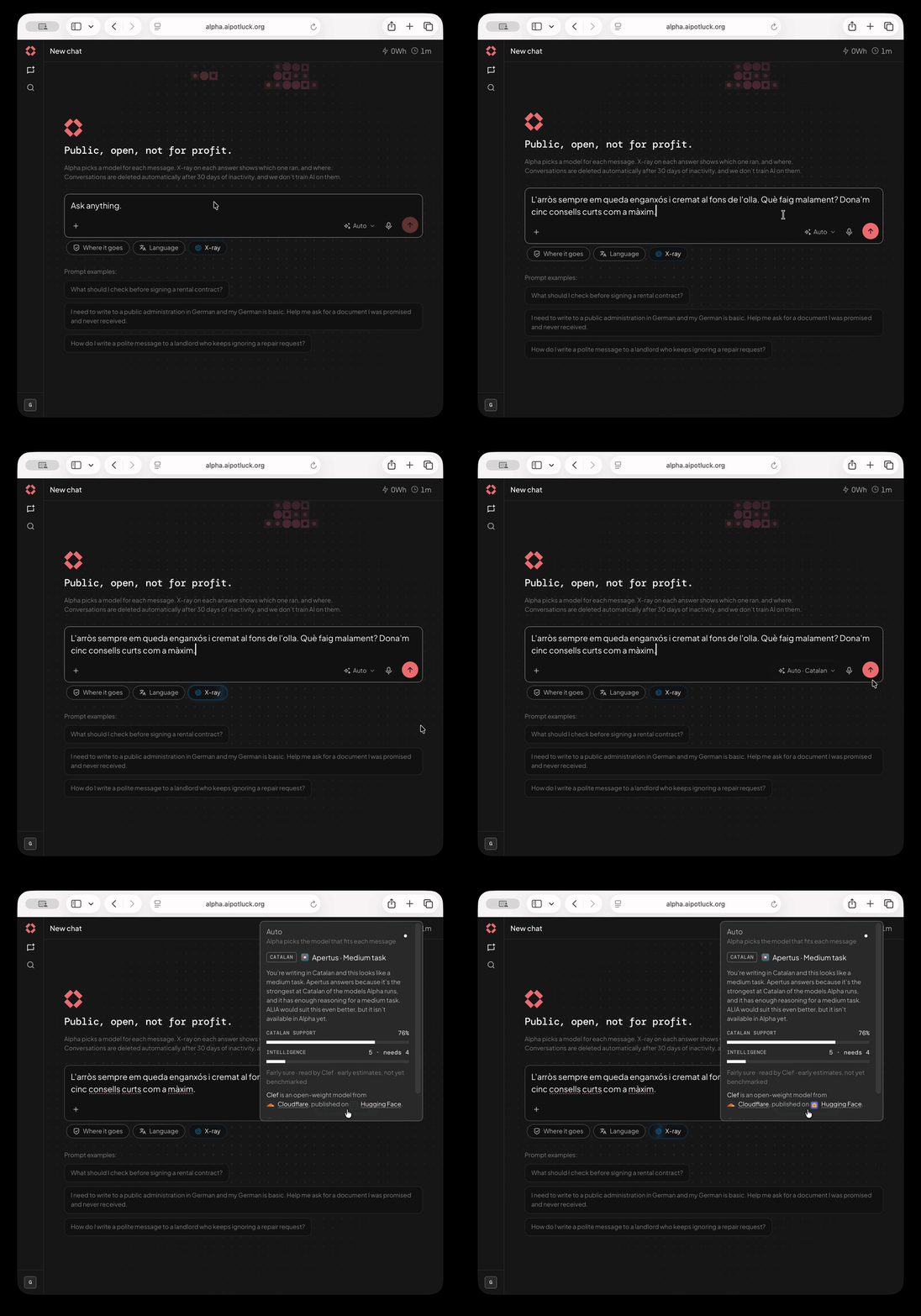
For Alpha v0.2, Collective Intelligence Project evaluated the available models across 122 languages using the Belebele reading-comprehension benchmark, helping Alpha’s model picker recommend a model based on the language you use.
Common Voice: A pathway from using AI to contributing
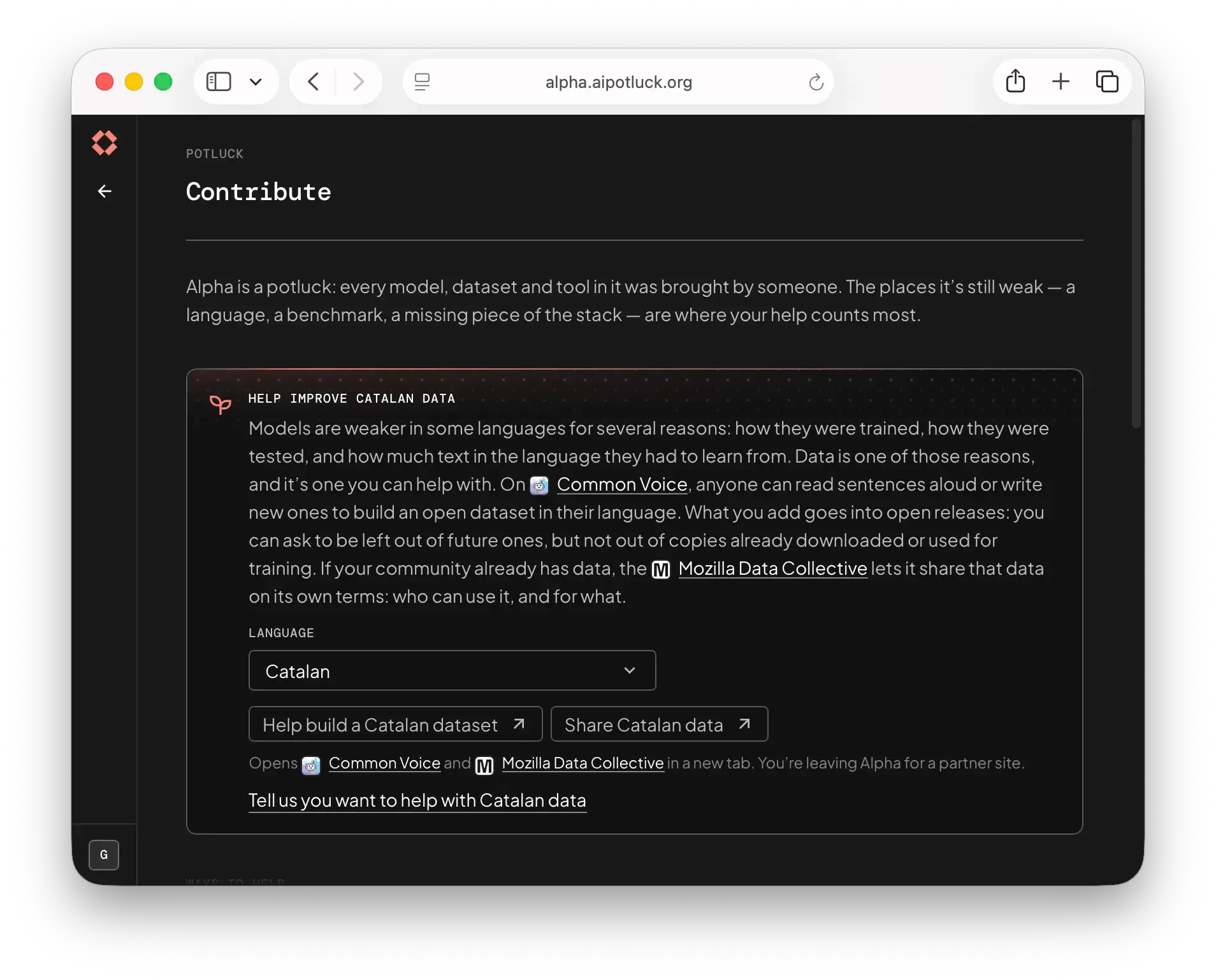
Common Voice expands what languages open AI can serve by collecting the voice and text data models are trained on. In Alpha v0.2, when someone is chatting in a language where available models are still weak, we surface that gap and point them to concrete ways to strengthen the commons—by reading, writing or reviewing sentences for Common Voice, or by sharing a dataset through Mozilla Data Collective, where you can contribute by sharing a dataset.
Taraaz: Bringing language evaluation into Alpha
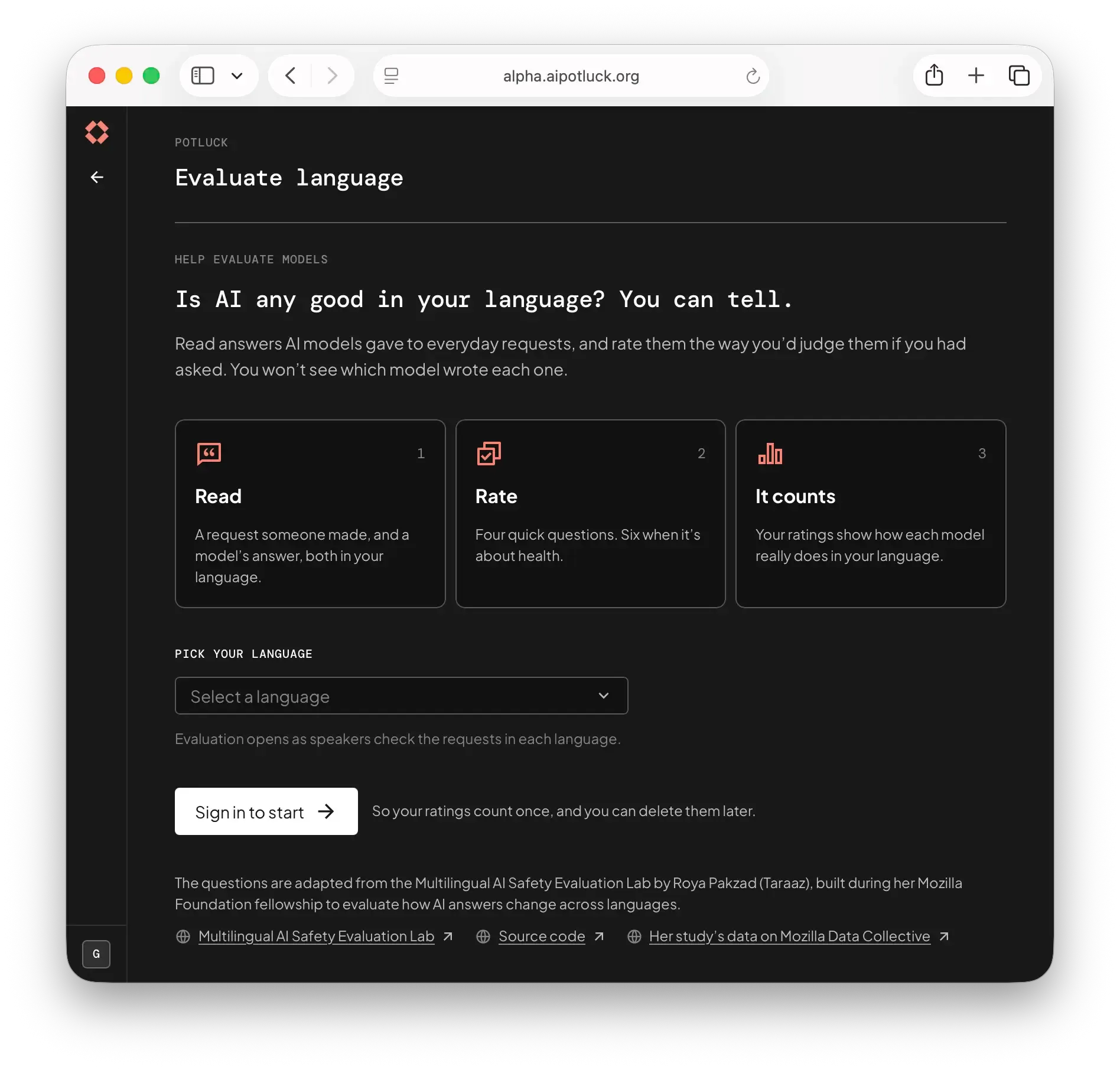
The Alpha team built an in-app evaluation tool using a method and codebase from Taraaz, with questions adapted from the Multilingual AI Safety Evaluation Lab. It was developed by Roya Pakzad during her Mozilla Foundation fellowship to examine how AI responses change across languages. In Alpha, people can now compare and rate anonymized model responses , starting with Italian, Portuguese and French, with more languages opening as native speakers review them. This brings human judgment into the evaluation process and gives people a way to contribute their language expertise.
United Nations Development Programme (UNDP): Grounding design in real-world needs and ambitions
UNDP joins Potluck as a design research partner to explore: What does it mean to serve the public interest with AI, and what do local communities need and expect from their AI systems?
Drawing on insights from two years of UNDP’s Local Language Accelerators, AI Landscape Assessments across 11 countries, and a global network of teams working to understand how people around the world use, adapt, and experience AI, our collaboration grounds Potluck’s product development and delivery in the realities of communities and public institutions, particularly across the Global South.
UNDP will contribute its research, insights, and public goods already deployed across countries and communities, while we help to make these resources more accessible through interoperability and visibility on shared infrastructure.
What will you bring?
These contributions span models, evaluation, data, research and participation. Each fills a different need and makes the next opportunity to contribute easier to see.
AI Potluck is an invitation to build a public-interest alternative together. Explore Alpha, find a gap, and help shape what comes next.
Partners
 Horizontal Logo CMYK Full Colour.png)