Version 0.6.0 – last update 20 Nov 2026

Open(ish) products
1,050
Gaps to fill
42
See the latest updates ›

How to read the map

Maturity stage:

The maturity stage looks at the fully open options within a category. The higher the stage, the more the category can rely on fully open options.

  • 1/5 Fully open products are absent
  • 5/5 Mature Open Ecosystem

Openness:

Every product is assessed with an openness score, and is typed as Open Source, Open-ish or closed. This map only shows the first 2 types.

Open source
Open-ish

Product score:

Every product carries a score on a 1–5 scale, blending capability and adoption. Products scoring 4.5 or above are leading, those from 4.0 to 4.5 are strong, and everything below is shown outlined.

  • Leading (4.5 or more)
  • Strong (4.0 to 4.4)
  • Available (below 4.0)

Gaps:

Gaps are indicators of where a category should improve. A category can have multiple gaps, and are set by clear rules

c Capability gap
a Adoption gap
r Resiliency gap
o Openness gap
d Disclosure gap

More information about stages and gaps can be found on the Methodology page

The 3 layers of the AI stack

The gap map follows the three layers you need to build an AI system, as defined at the 2024 Columbia Convening on Openness in AI. Each layer is split into its own product categories, and every category gets its own score based on the identified gaps within.
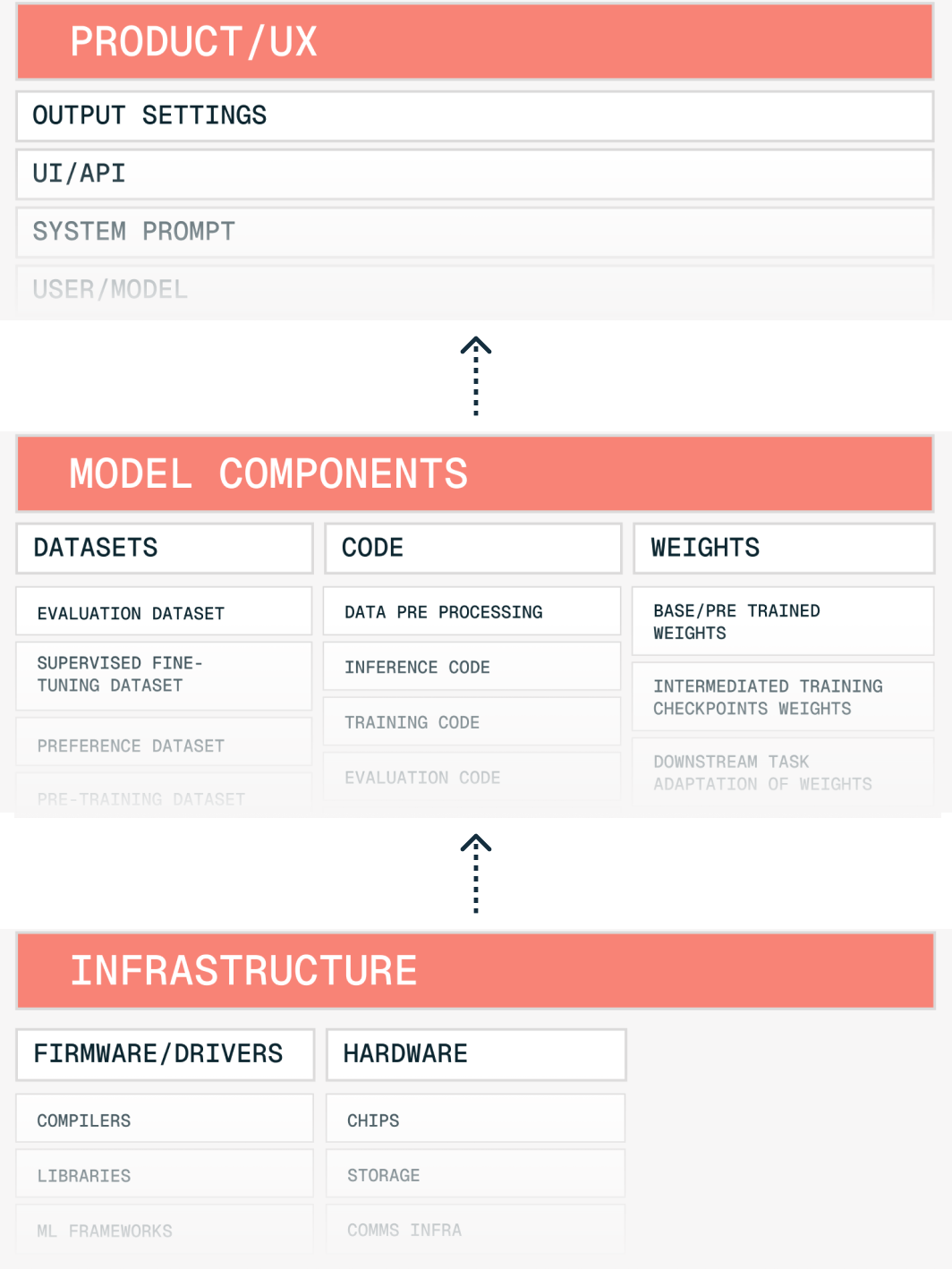
The AI stack as three stacked layers: Product / UX on top, Model components in the middle, Infrastructure at the base, with arrows showing each layer building on the one below.

Product / UX

Product design choices and UX components determine what the AI system can be used for, what data it can access to execute its functions, and are responsible for providing a secure, appealing, and reliable experience to users; as well as collecting data to support developers.

Model Components

Training data, model weights, and adaptation pipelines determine how underlying AI models respond to specific inputs, shaping the underlying statistical behaviors that can be translated into AI outputs and activities.

Infrastructure

Compute, deployment, and runtime systems determine where models run, how reliably they respond under real use, and what constraints govern their operation; as well as providing the foundations developers need to build, host, and monitor production systems.

Product / UX

10 product categories · 10 gaps found

Model components

19 product categories · 24 gaps found

Infrastructure

8 product categories · 8 gaps found